← The Stargazer · vibealive.us museum
Kulaksizlar · Middle Chalcolithic
The workshop
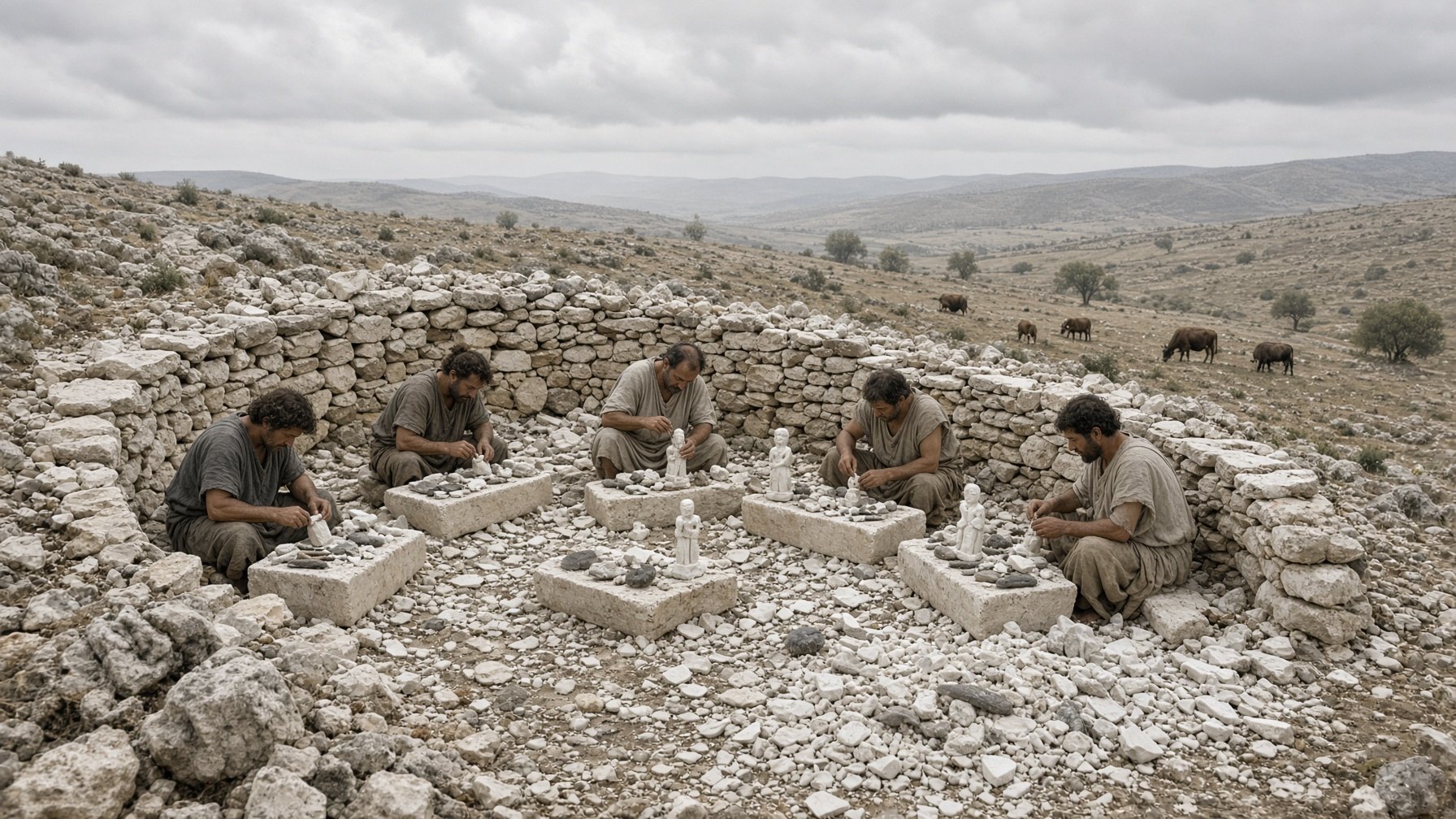
Before the Cleveland marble entered a vitrine, figures of this type were roughed out, pecked, drilled, and polished in a hillside workshop on the Akhisar plain. Kulaksizlar is the one production center we can still name.
The site
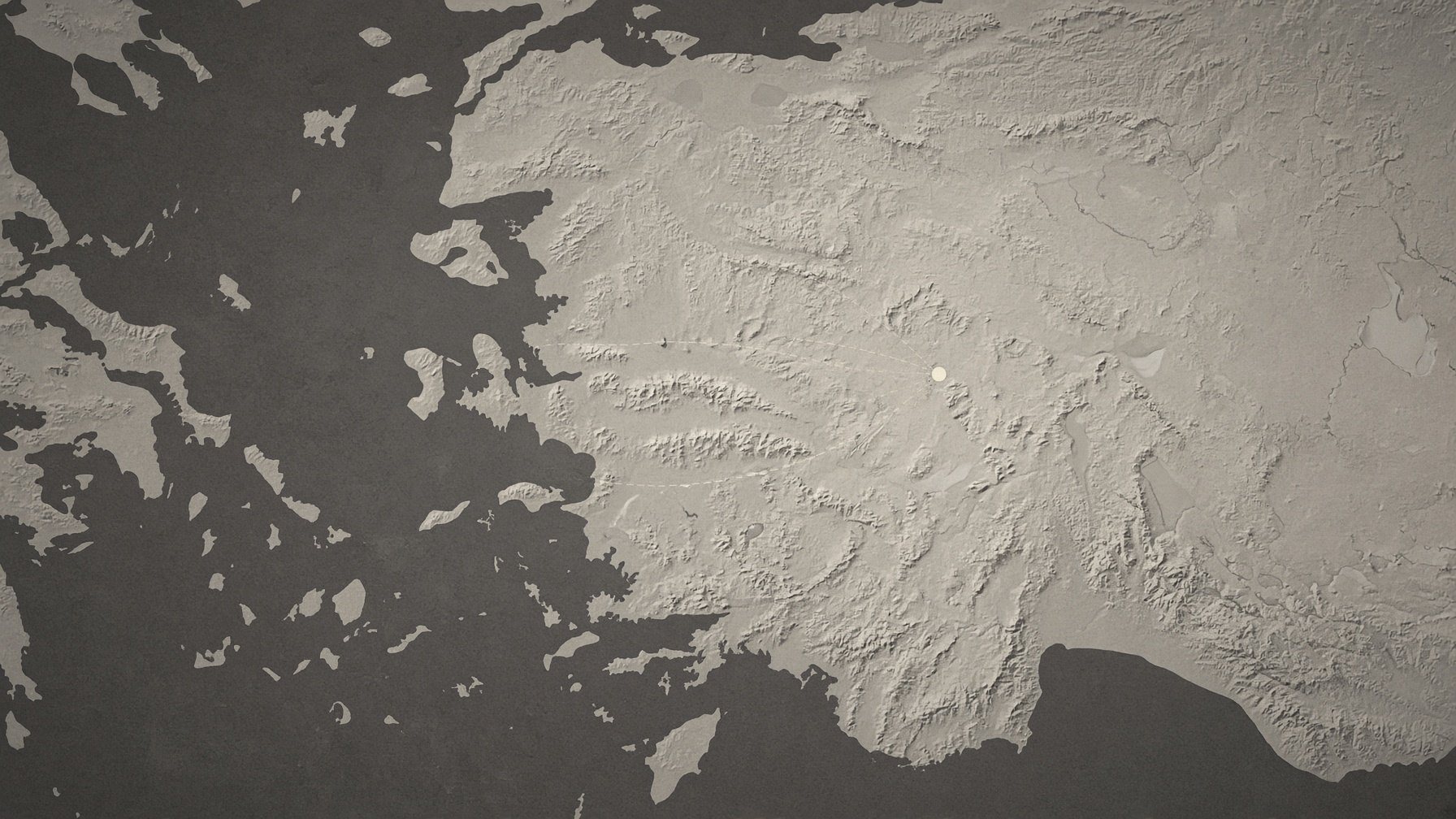
Kulaksizlar is a single-period Middle Chalcolithic settlement and marble workshop near the modern village of the same name, in the Akhisar district of Manisa, western Anatolia. It sits on a gentle limestone hillside at about 150 m, on the eastern edge of the Akhisar plain. Cultural deposits are thin — twenty to forty centimetres — which preserved workshop floors and left them open to the plough and to looting.
Surface survey in the mid-1990s, by Rafet Dinc, first marked the place. Turan Takaoglu later established it as a rare prehistoric specialist workshop in marble. Rescue excavations in 2018 and 2019, under the Manisa Museum and the Ministry of Culture, gave the first stratified contexts: clustered installations rather than a dense village.
Radiocarbon dates from workshop contexts place Kulaksizlar in the Middle Chalcolithic, 4500–4250 BC. The Cleveland Museum of Art dates marble 1993.165 to c. 3000 BCE and the early Bronze Age. The Kilia form is the type; the museum piece is a finished example of that tradition, not a find from the workshop floor.
Making
Two product classes dominate: Kilia-type schematic marble figurines, and conical marble rhyta — pointed vessels with paired suspension lugs.
- 01 · Stone Fine-grained local or regional marble, brought to the hillside as blocks.
- 02 · Preform Roughing-out into blocky, roughly anthropomorphic or conical blanks.
- 03 · Shape Pecking, abrasion, and grinding with stone hammers and sandstone.
- 04 · Hollow For rhyta: interior hollowing with bow-drills and sandstone bits. Drill bits were recovered on the floors.
- 05 · Incise Low-relief faces — almond eyes, triangular nose, small ears — and the pubic triangle and arm folds.
- 06 · Polish A last pass to a smooth, luminous skin. Finished pieces left the site.
Waste is diagnostic: discarded necks, unfinished heads, body preforms, conical fragments with rotary striations. Obsidian from Melos and from central Anatolia lies on the work platforms.
The type
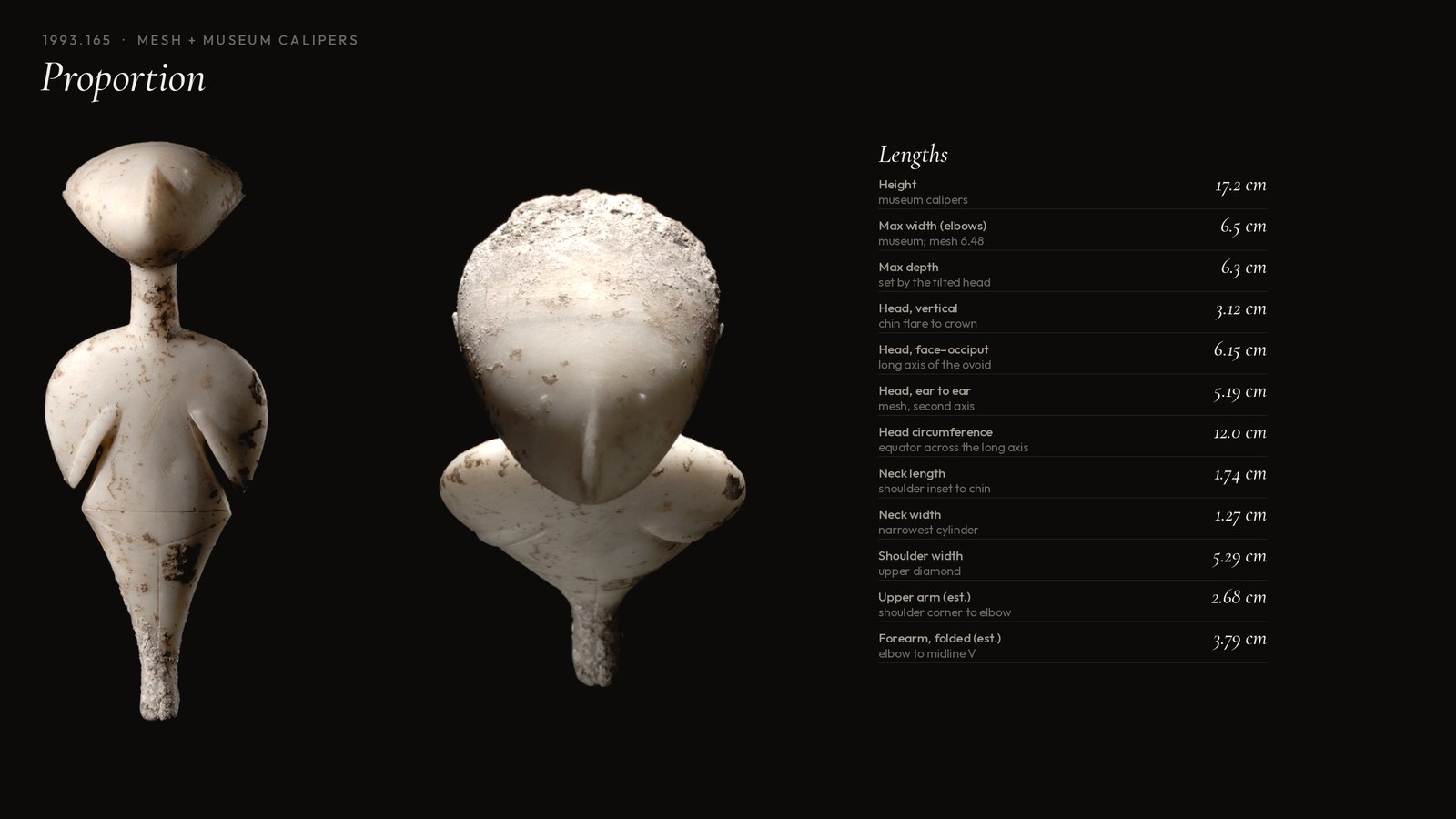
The type takes its name from Kilia, on the Gallipoli peninsula. The form is highly standardized: a flat broad torso; a long cylindrical neck; an oversized head tilted far back — the museum nickname “Stargazer”; low-relief almond eyes and triangular nose; an incised pubic triangle. Heights run from a few centimetres to museum pieces of 15–25 cm. Cleveland’s marble is 17.2 cm.
The bounding rectangle (height over max width, 17.2 / 6.5 = 2.65) sits within about 1% of φ². The folded arms, read from the front photograph, give forearm over upper arm ≈ √2. A square’s diagonal — a ratio a maker can take with a cord.
Meaning
These were not ordinary house things. Finished figurines and conical rhyta moved across western Anatolia, and the type reached the islands. The gaze, the swollen head, the repeated female schema invite the usual readings — fertility, ancestry, a watch on the sky. We do not know how Cleveland’s piece was used. The form still asks.
Complete examples bring high prices. Looting at Kulaksizlar and related sites has stripped context. The 2018–2019 seasons were, in part, a race to record what the plough and the market had not yet taken.
Finds
- Islik A (U-shaped) — primary conical rhyton production; platforms with obsidian; sandstone drill bits.
- Islik C (oval) — dense Kilia figurine waste and unfinished pieces; every production stage.
- Islik D — near-finished broken figurines; closest approach to complete examples at the site.
- Dagdere — finished Kilia fragments and rhyta about 30 km away (intra-regional exchange).
- Becin Castle — a Kilia head in medieval layers: residual deposition or a curated object.
- Museum completes — Getty, Sadberk Hanim, Istanbul, Menil, Cleveland: finished products that left the workshop.
Close
Kulaksizlar remains a landmark for specialist craft in the mid-fifth millennium — well before the better-known Cycladic marble of the Early Bronze Age. The Cleveland figure looks up, and the hillside that likely taught that pose is on the record.
Synthesized from Akdeniz 2010; Takaoglu 2005–2022; Pektas 2021; and the CMA object record for 1993.165. Photographs of 1993.165 and the 3D mesh are Cleveland Museum of Art, Open Access, CC0. Workshop reconstruction and map are newly made illustrations for this page.